 0
0
 0
0
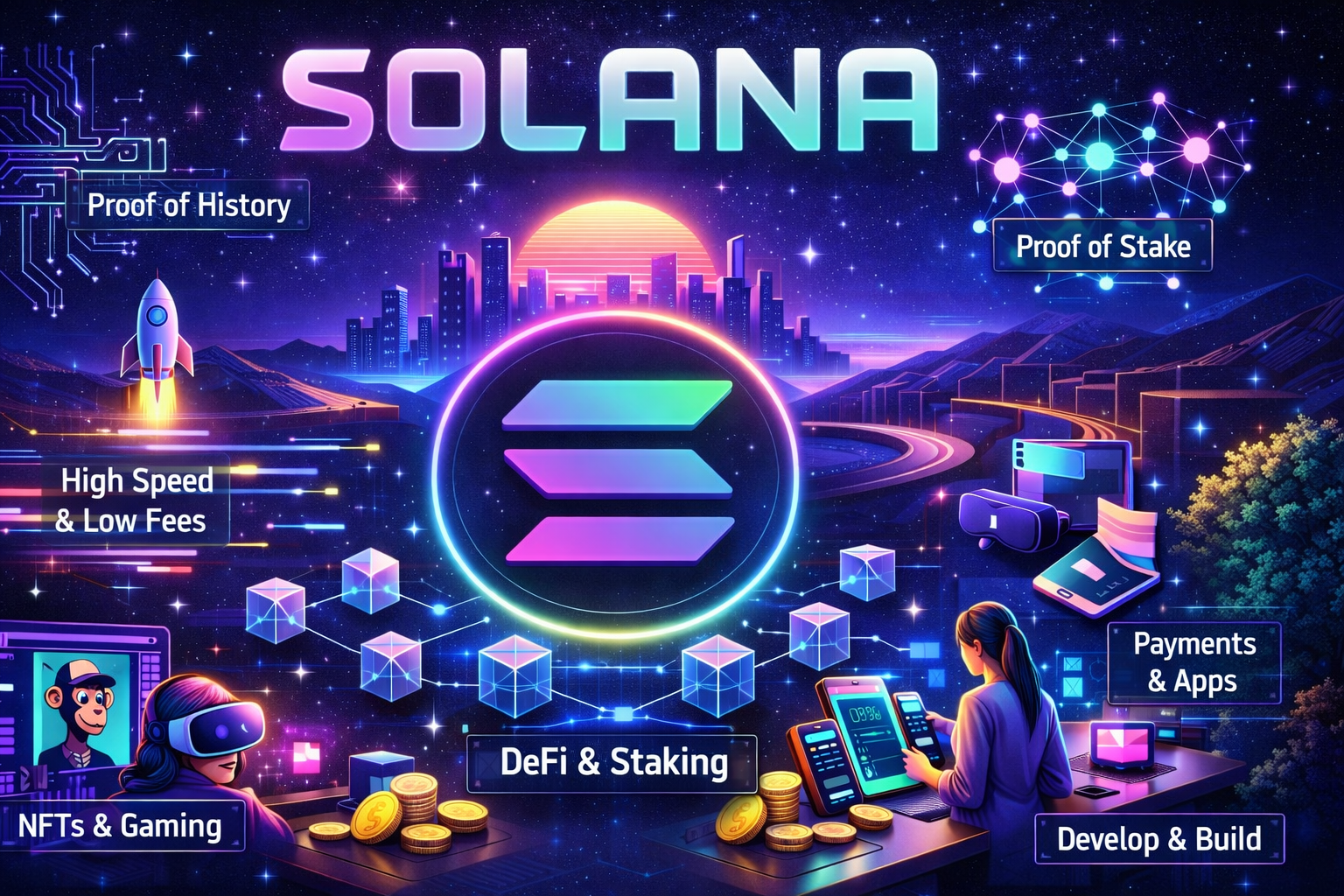
Solana is one of the most prominent Layer-1 blockchain platforms in the crypto industry, known for its high throughput, low transaction costs, and strong developer ecosystem. Since its launch in 2020, Solana has positioned itself as an infrastructure layer designed to support mass-scale decentralized applications, from DeFi and NFTs to gaming, payments, and real-world use cases.
Origins and Vision
Solana was founded by Anatoly Yakovenko, a former Qualcomm engineer, with the goal of solving blockchain scalability without sacrificing decentralization or security. The core vision is to create a blockchain capable of operating at internet scale, enabling thousands of transactions per second while keeping fees negligible.
The Solana Foundation, based in Switzerland, supports ecosystem growth, grants, and developer adoption worldwide.
Core Technology and Architecture
Solana’s performance advantage comes from a unique combination of innovations rather than a single breakthrough.
Proof of History (PoH)
- A cryptographic clock that orders transactions before they enter consensus.
- Reduces the need for nodes to communicate extensively about time and order.
- Enables faster block production and lower latency.
Proof of Stake (PoS)
- Validators stake SOL to secure the network.
- PoS works alongside PoH to confirm blocks efficiently.
- Encourages decentralization through economic incentives.
Parallel Processing (Sealevel)
- Smart contracts can run in parallel rather than sequentially.
- Enables high throughput for DeFi, NFTs, and on-chain games.
Other Key Components
- Turbine: Efficient block propagation protocol
- Gulf Stream: Mempool-less transaction forwarding
- Cloudbreak: Horizontally scalable accounts database
Together, these allow Solana to process tens of thousands of transactions per second under optimal conditions, with fees often measured in fractions of a cent.
SOL Token Utility
The native token, SOL, plays several essential roles:
- Transaction fees
- Staking and network security
- Governance participation (future development)
- Collateral in DeFi protocols
SOL has a dynamic inflation model, with inflation decreasing over time and a portion of transaction fees being burned, creating long-term deflationary pressure as usage increases.
Ecosystem and Use Cases
DeFi
Solana hosts a growing DeFi ecosystem including decentralized exchanges, lending platforms, and derivatives protocols. Its speed and low fees make it attractive for:
- High-frequency trading
- On-chain order books
- Retail-friendly DeFi access
NFTs and Digital Assets
Solana gained major attention during the NFT boom due to:
- Extremely low minting costs
- Fast confirmation times
- Popular marketplaces and creator communities
Gaming and Web3 Apps
Real-time applications such as on-chain games, social platforms, and metaverse experiences benefit from Solana’s low latency and scalability.
Payments and Consumer Apps
Solana is increasingly used for:
- Micropayments
- Stablecoin transfers
- Point-of-sale and mobile payment experiments
Developer Experience
Solana emphasizes developer performance and composability:
- Supports Rust, C, and C++ for smart contracts.
- Offers robust tooling, SDKs, and APIs.
- Strong grant programs and hackathons drive innovation.
While the learning curve can be steeper than EVM-based chains, developers gain access to significantly higher throughput.
Challenges and Criticism
Despite its strengths, Solana has faced notable challenges:
- Network outages (historically): Past congestion and validator issues raised concerns about reliability.
- Hardware requirements: Running a validator can be costly, potentially impacting decentralization.
- Complex architecture: Debugging and maintaining high-performance systems is harder than simpler chains.
Recent upgrades and client diversity efforts aim to improve stability and resilience.
Competitive Position
Solana competes directly with:
- Ethereum (and its Layer-2 ecosystem)
- Avalanche
- Sui and Aptos
- Near Protocol
Its main differentiator remains monolithic high-performance design, in contrast to Ethereum’s modular, Layer-2-centric scaling approach.
Future Outlook
Solana’s roadmap focuses on:
- Improved validator clients and network stability
- Greater decentralization
- Enhanced tooling and consumer-grade applications
- Deeper integration with real-world finance and payments
As Web3 shifts toward user-friendly, high-volume applications, Solana’s architecture positions it well to support the next wave of adoption.
Conclusion
Solana represents a bold approach to blockchain scalability, prioritizing speed and usability without relying on Layer-2 solutions. While it has faced growing pains, its technological foundation, vibrant ecosystem, and strong developer momentum make it one of the most influential platforms in the blockchain space today.
If you’d like, I can also write a comparison article (Solana vs Ethereum) or a business-focused overview for investors or enterprises.

