 0
0
 0
0
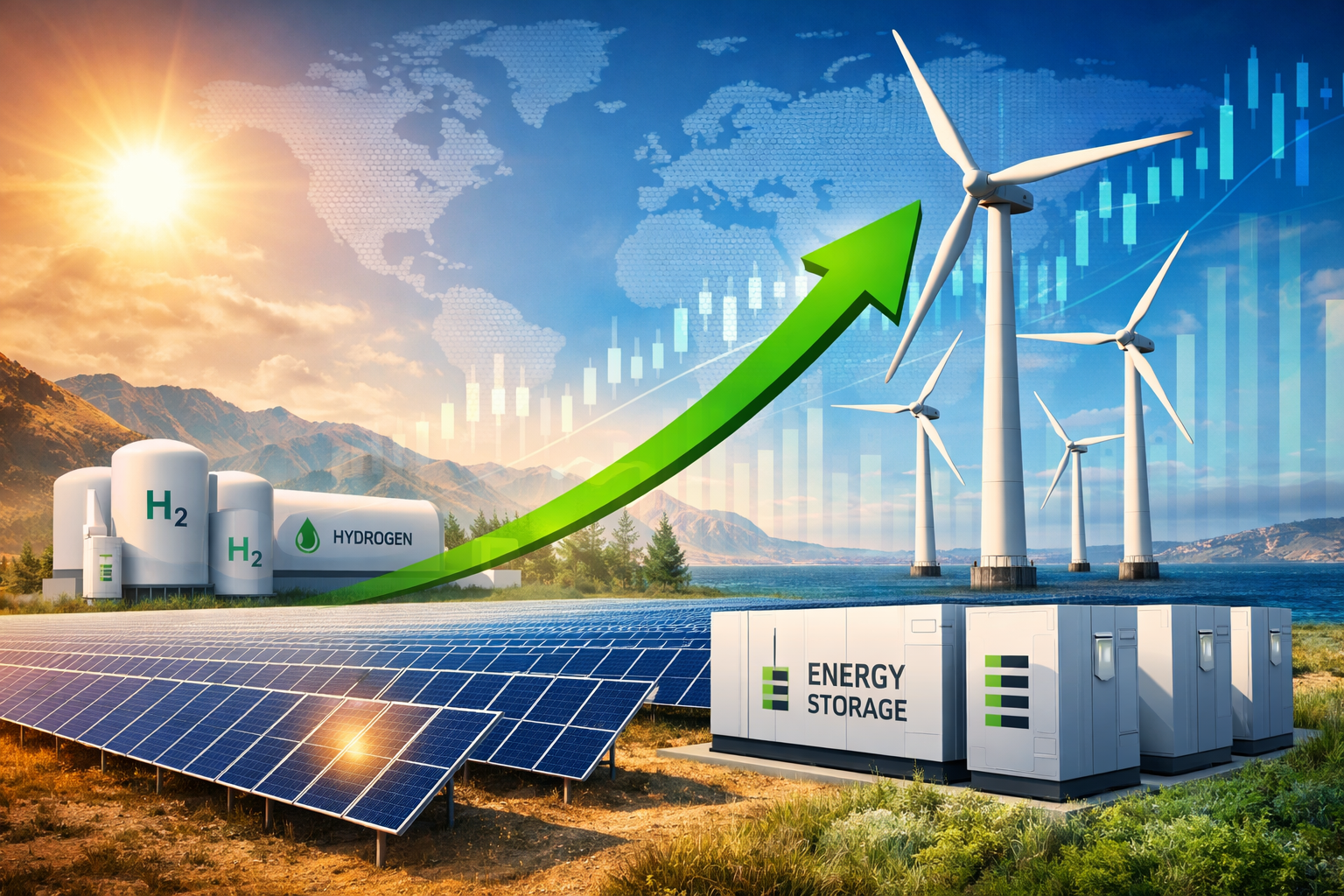
How Solar, Wind, Storage and Hydrogen Are Reshaping the Global Energy Market
1. Solar PV: Racing Toward 35% Efficiency
Solar technology has moved far beyond traditional panels.
- PERC (Passivated Emitter and Rear Contact) cells laid the foundation for modern mass production.
- TOPCon (Tunnel Oxide Passivated Contact) and HJT (Heterojunction) technologies now dominate high-efficiency markets, pushing laboratory conversion rates beyond 26%.
- Next-generation perovskite-silicon tandem cells are approaching commercialization, with theoretical efficiencies of up to 35% — a potential breakthrough that could redefine solar economics.
Higher efficiency means lower land use, reduced balance-of-system costs, and faster returns on investment — critical factors for large-scale deployment.
2. Wind Power: Bigger, Smarter, Offshore
Wind turbines are getting both larger and more intelligent.
- Onshore units now exceed 10MW.
- Offshore giants surpass 18MW, turning coastal waters into high-capacity energy hubs.
- AI-driven smart control systems optimize blade pitch and yaw angles in real time, increasing output by 15–20% in low-wind regions.
Wind is no longer constrained by geography; digital optimization is unlocking new value in previously marginal zones.
3. Energy Storage: The Grid Stabilizer
As renewables expand, storage becomes essential.
- Lithium iron phosphate (LFP) batteries dominate short-duration storage (<4 hours).
- Flow batteries (vanadium and iron-chromium systems) serve long-duration needs (>8 hours).
- Non-electrochemical solutions such as compressed air and gravity-based storage are entering pilot-to-commercial scaling stages.
Storage is transitioning from “supporting technology” to strategic infrastructure — stabilizing grids and enabling 24/7 clean power.
4. Green Hydrogen: The Industrial Decarbonizer
Hydrogen is emerging as the bridge between renewable electricity and hard-to-abate sectors.
- PEM (Proton Exchange Membrane) and alkaline electrolyzers now exceed 75% efficiency.
- Solid-state hydrogen storage materials, including magnesium-based alloys, are addressing transportation and safety challenges.
Green hydrogen could reshape heavy industry, shipping, and long-duration energy storage in the coming decade.
The Teams Behind the Breakthroughs
Behind the hardware are highly specialized research teams pushing performance limits.
LONGi Green Energy
The R&D division of LONGi Green Energy includes over 3,000 experts in material physics and semiconductor engineering. The company leads commercial TOPCon production with 25.8% efficiency and received the 2023 China Patent Gold Award.
Goldwind Research Institute
Goldwind developed the world’s first 16MW offshore wind turbine. Its research team includes national-level experts and holds one of the industry’s largest patent portfolios.
CATL Energy Storage Division
CATL pioneered long-life LFP batteries exceeding 12,000 charge cycles and supported a 100MW/400MWh solar-storage project in Qinghai, demonstrating grid-scale integration capabilities.
The World’s Largest Single PV Base
In the high-altitude Gobi landscape of Qinghai stands one of the most ambitious renewable projects ever built — the Qinghai Tala Photovoltaic Park.
- Installed capacity: 3,450MW
- Area covered: 609 km²
- Annual generation (2023): 4.5 billion kWh
- CO₂ reduction: 3.8 million tons annually
- Households powered: ~2 million
The park uses LONGi Hi-MO 5 modules (21.7% efficiency) alongside a 150MW/600MWh lithium battery storage system.
But its innovation goes beyond electricity.
By adopting a “PV + pasture planting” model, vegetation coverage in the area increased from 30% to 60%. Solar panels provide shade, reduce soil evaporation, and create microclimates that restore grassland ecosystems — proving renewable energy can drive ecological rehabilitation, not just carbon reduction.
Satellite imagery shows a vast “blue ocean” of PV panels across the desert, punctuated by wind turbines — a visual symbol of how technology is transforming barren land into a productive, sustainable asset.
The Bigger Picture
Renewable energy is no longer a niche sector driven by environmental idealism. It is:
- A geopolitical strategic industry
- A trillion-dollar investment frontier
- A technological arms race in efficiency and storage
- A core solution to climate resilience
As efficiency rises, costs fall, and storage scales, the renewable energy technology industry is entering its acceleration phase. The question is no longer whether clean energy will dominate — but how quickly the global system can adapt to its momentum.
Disclaimer: The article does not constitute financial, investment, or trading advice. It is recommended that readers consult with qualified financial advisors, conduct thorough due diligence, and consider their individual financial circumstances and risk tolerance before making any investment choices.
